


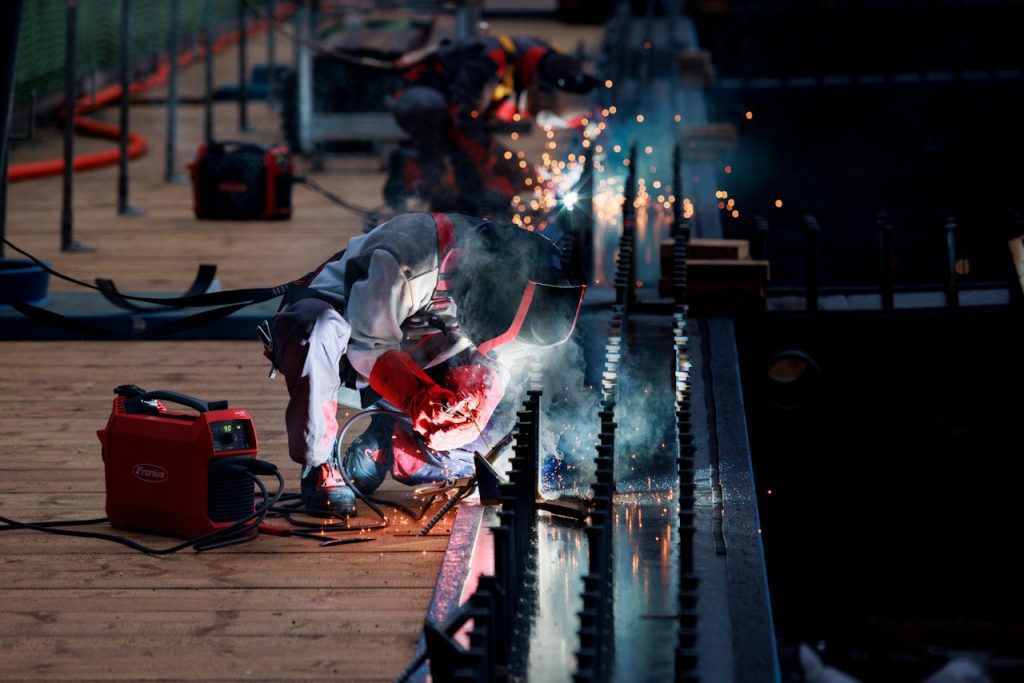
When we think about manual welding, we picture gleaming arcs, flying sparks, and plumes of smoke. But this picture falls short of reality, because visible risks such as arc radiation, hot metal spatter, or welding fumes can be managed effectively with modern protective equipment and clear safety standards. However, one often underestimated aspect is a hazard that remains unseen: electrical current.
Text & images by Fronius
Even a brief moment of carelessness can have serious consequences: a sudden shout prompts an instinctive turn, and an unprotected hand reaches for the stick electrode. Now, the body has become part of the circuit. In cases like this, insulating work shoes or a welding mat made of nitrile rubber interrupt the flow of electricity and provide reliable protection. Electrical current always takes the shortest path through the body between the point of entry and the point of exit. If it runs through both hands, for example, the current not only flows through the arms and upper body, but also vital organs such as the heart – with potentially fatal consequences.
Caution around open circuit voltage
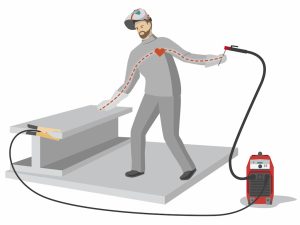
While live parts of commercially available electrical appliances are protected against contact, arc welding poses an increased risk because the open circuit voltage can become dangerous contact voltage – especially if the workpiece (ground) and the electrode or non-insulated parts of the electrode holder are touched at the same time. In this case, the current travels through the human body. Depending on the operating conditions, fixed maximum limits apply to the open circuit voltage. There is an electrical hazard to humans starting at voltages of more than 25 V AC (RMS) or 60 V DC, and where there is the potential for a sufficiently high current to flow at the same time.
Even low amperages can be lethal
When electrical current travels through the human body, it has a stimulating effect on muscles, nerves, and the cardiovascular system. Potential consequences range from muscle cramps and respiratory arrest to “current marks” – small, point-like burns at the entry and exit points of the current. Amperages of 30 milliamperes or more pose an acute risk to life. The “let-go current” is between 10 and 15 mA for alternating current and around 50 mA for direct current. If this threshold is exceeded, muscle cramps can be so severe that those affected are no longer able to let go of live parts without assistance.
Alternating current is significantly more dangerous than direct current, as it can affect the heart’s natural rhythm and trigger ventricular fibrillation. Another factor that is often underestimated is that even low amperages of between 1 and 10 mA are sufficient to trigger involuntary reflex movements, which often result in secondary accidents. These uncontrolled reactions could, for example, lead to a fall from a ladder or other injuries.
In addition to the amperage, the duration of exposure to the human body plays a decisive role in the risk of injury. The longer the flow of current lasts, the more serious the impacts on health. For this reason, it is essential that welding specialists wear suitable protective equipment at all times. In Europe, welding gloves must meet the requirements of the EN 12477 standard, while work shoes should be protection class S3 in accordance with EN ISO 20345.
How do you determine the danger?
The amperage (I) is dependent on the applied voltage (U) and the resistance (R) and follows Ohm’s law (U = R x I). If you want to determine the amperage, a human resistance (without protective equipment) of 1,000 ohms can be assumed from hand to hand or hand to foot. If the welding machine has an open circuit voltage of 50 V according to the rating plate, a potentially lethal current of 50 mA can pass through the body in accordance with Ohm’s law (I = U / R).
Working with several machines
If welders work on a workpiece with several welding machines at the same time or on components with a conductive connection, the contact voltage that occurs—especially the open circuit voltage—can reach levels higher than permitted. In many cases, this hazardous situation is not immediately evident.
But the situation becomes especially critical when welding with different polarities at the same time. In this case, the total open circuit voltages of the welding machines can lead to dangerously high voltage levels when welding with direct current (DC).

“This happens fairly often, especially on construction sites,” reports Franz Bichler, a welding trainer at Fronius International. “In the past, we often worked in pairs or threes when welding components several meters long – and even with different polarities, to get the best results on complex components. If the grounding is faulty in a situation like this, the accumulated voltage can pass through the welder’s body—with life-threatening consequences such as electric shocks, cardiac arrhythmia, or severe burns.”
When welding with alternating current (AC), both the polarity of the circuits and the grid-side connection of the devices influence the resulting open circuit voltage. Under less favourable conditions, the contact voltage can increase to the total of all open circuit voltages of the devices used. Therefore, it is essential to measure the voltage between the welding torches or electrode holders before starting work. The measurement is carried out with a voltmeter by placing both measuring tips directly on the welding torch (electrode holder).
Employer’s duty to protect and inform
Employers must implement protective measures to prevent accidents and ensure welders are aware of hazards. Safe working conditions follow international standards. Welders must be spaced to avoid simultaneous contact with two torches; if not possible, use insulating partitions. Voltage must never exceed the permissible open-circuit limit.
Key safety measures:
- Only use machines in perfect condition; switch off and unplug those not in use.
- Operate devices according to the protection class on the rating plate.
- IP21 devices are for dry indoor areas; IP23 or higher is needed outdoors.
- Connect return cables close to the weld area, ideally to the workpiece or its support.
- Disconnect power immediately if faults occur and report damage. Do not use or open defective devices.
Stray welding current hazards
Improper return cable connections and careless electrode placement can interrupt ground conductors and create severe risks. Avoid using metal poles, chains, or crane ropes as return cables. Clamp the return cable directly to the workpiece or use magnetic poles.
If welding suspended workpieces, insulate with dry ropes or an insulated swivel hook. Suspended work baskets require proper insulation. Only use insulated tools when welding and working with power tools simultaneously.
Working with high electrical voltage
There is an increased risk of electrical hazards in workplaces with restricted freedom of movement. This applies in particular when welding specialists have to work in forced postures – such as kneeling – and come into contact with electrically conductive parts. Areas that are completely or partially surrounded by electrically conductive materials also present hazards. Even contact that is unavoidable or accidental can lead to electric shocks.
You can use the following rule of thumb to assess whether there is an increased risk during arc welding: If the free space between electrically conductive parts positioned opposite one another is less than two meters – in length, width, height, or diameter – you should assume that there is an increased electrical risk.
Make sure to take particular care in wet, damp, or hot workplaces, as the resistance of human skin, protective clothing, and protective equipment may be significantly reduced by moisture or perspiration in these environments. Workplaces should be considered “wet” if workwear is soaked with moisture and can therefore conduct electricity, which significantly increases the risk of an electrical accident.
Protective measures
Only approved welding machines marked with the [S] symbol may be used for work involving an increased electrical hazard. Special protective measures are also required to ensure welding specialists are protected from electrically conductive parts as well as damp floors and walls by means of insulating underlays or intermediate layers of material.
If this shielding cannot be provided due to additional hazards—such as a risk of falling—or a lack of space, work may only be carried out while wearing dry, undamaged workwear. In situations where you cannot guarantee that clothing will remain dry, such as in hot environments, only direct current machines may be used for manual arc welding.
The open circuit voltage of the devices used should be kept as low as possible—depending on the welding tasks and device properties—and must not exceed 75 V. Welding machines must not be set up in the immediate danger zone. Protective extra-low voltage must be used for remote control of these devices.
Ensure that welders do not work alone on these jobs; suitable supervision must be provided. Only qualified specialists may carry out welding work involving an increased electrical hazard.
Summary
Safety comes first when welding. Improper handling of welding machines can have serious consequences—especially due to high open circuit voltages, stray welding current, or when working in conditions involving increased electrical hazards. However, these risks can be significantly reduced by consistently observing suitable protective measures.
About the company
Established in 1945 by Günter Fronius, today Fronius is a pioneer in the development of welding technology. For information visit www.fronius.com
About this Tech Article
Appearing in the August 2025 issue of Stainless Steel World Magazine, this technical article is just one of many insightful articles we publish. Subscribe today to receive 10 issues a year, available monthly in print and digital formats. – SUBSCRIPTIONS TO OUR DIGITAL VERSION ARE NOW FREE.
Every week we share a new technical articles with our Stainless Steel community. Join us and let’s share your technical articles on Stainless Steel World online and in print.